 In this area
The Luxor issue
East Bank - Downtown, Luxor: where temples, rooftops and the Nile meet
Luxor’s most walkable quarter folds temples, souks, river views and late-night rooftop dinners into a few luminous blocks along the Corniche.
By Hana Abdel-RahimKarnak columns to Valley of the Kings
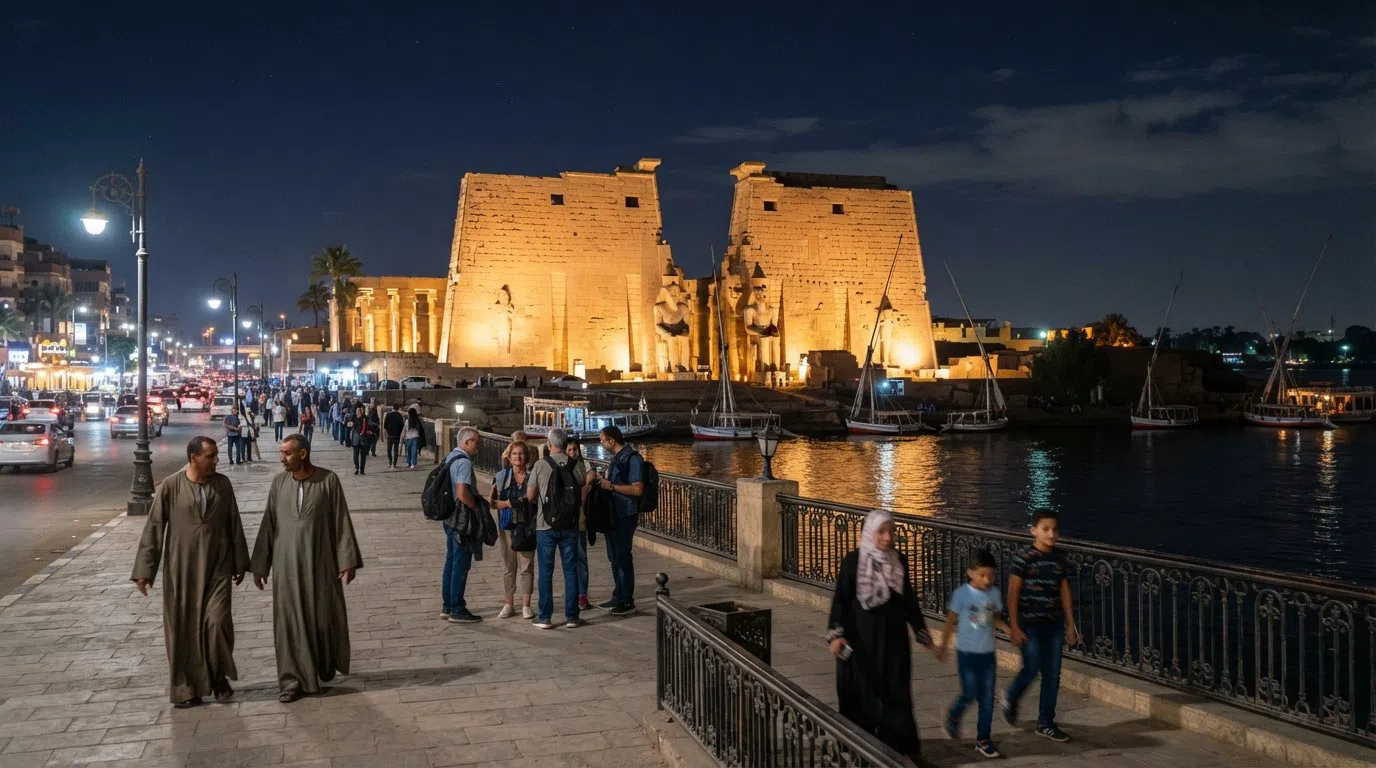
Stand on the Corniche el-Nil at dusk and East Bank - Downtown gives itself away in one frame: feluccas tacking home across a rose-gold river, the ram-headed sphinxes of the Avenue lit up, and Luxor Temple’s colossal Ramses statues catching the last light before the floodlights snap on.
What the East Bank is known for
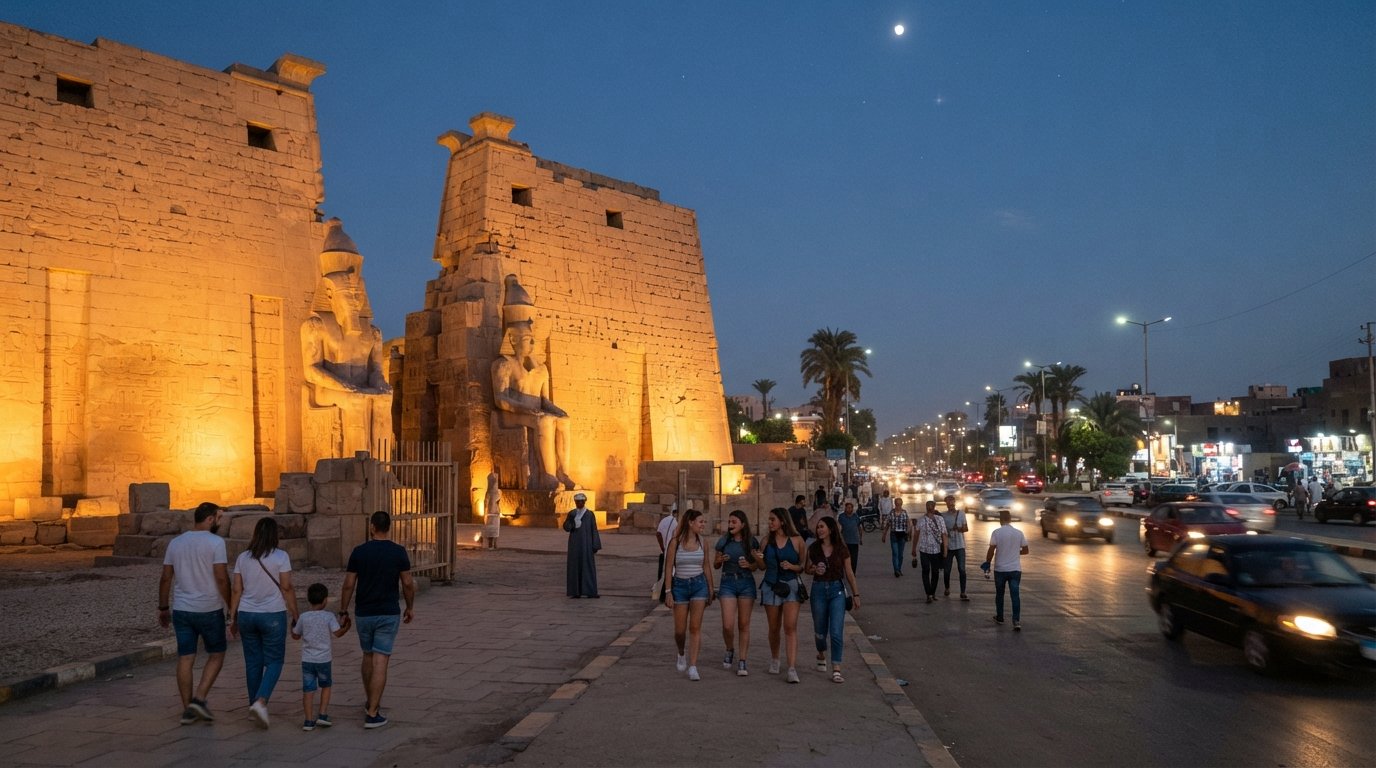
This is ancient Thebes’ ceremonial front door, and it still behaves like one. The downtown strip is compact enough to read at a glance, but it carries the weight of a city that has been staging arrivals for millennia. Luxor Temple sits right in the middle of it all, floodlit and open into the evening, with last entry around 7pm. Go once in daylight if you want the geometry; go again after dark if you want the mood. The statues throw long shadows then, and the whole place seems to exhale when the heat drops.
North of the temple, the restored Avenue of Sphinxes runs like a ceremonial spine through the city. It reopened in 2021, relaid with hundreds of ram- and human-headed sphinxes, and it stretches 2.7km to Karnak at the northern edge of downtown. It is one of those projects that can sound like heritage PR until you walk it and feel the scale of the old processional route under your feet. The avenue does not merely connect two monuments; it gives the city its old rhythm back.
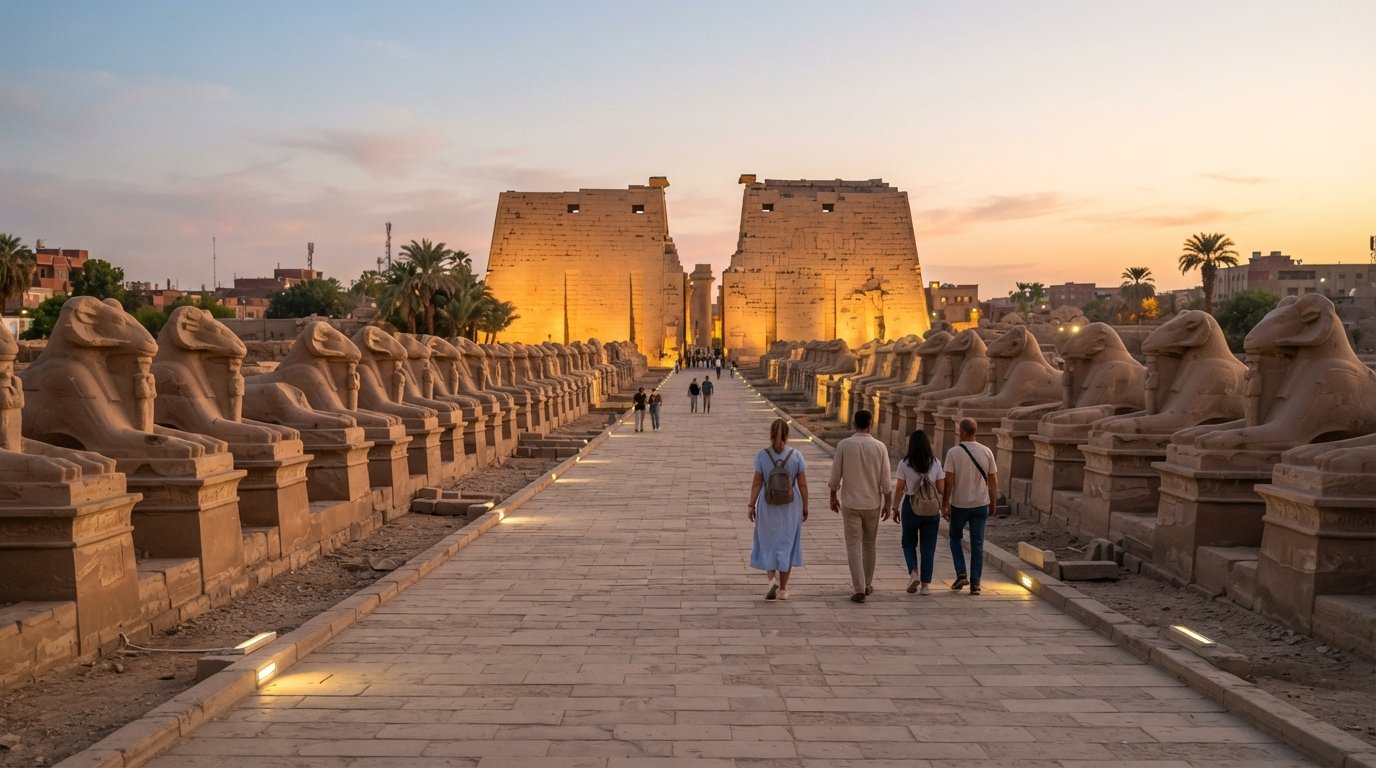
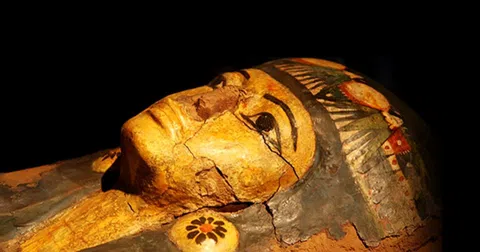
Between the temples, strung along the Corniche, are two smaller stops that reward an hour each and a little attention. The Luxor Museum is small, superbly curated, and beautifully lit; the Mummification Museum is more specific, more gruesome, and exactly the kind of place that makes ancient Egypt feel like a lived system rather than a postcard. One is for statuary and polish, the other for the practical, unsettling business of preserving the dead. Together they fill in the space between the giants.
What ties the whole district together is the Corniche el-Nil itself. This is the riverfront promenade where calèche drivers call out, juice sellers stack pyramids of oranges, and shisha smoke drifts from cafés facing the water. It is loud, a little theatrical, and completely legible on foot. The soundtrack is car horns, the muezzin, the clip-clop of carriage horses and a hundred simultaneous hellos. Downtown runs on a two-shift rhythm: hot and slow through the middle of the day, then busy and sociable again from late afternoon until well past midnight, when the floodlit temple and cooler air pull everyone back outside.
Plan your Luxor trip
Live prices from our booking partners.
Guests & rooms
Free cancellation on many rooms. We may earn a commission when you book.
Where to eat & drink
The East Bank has the city’s best concentration of restaurants, and the mood here is not subtle. Dinner is part of the district’s identity, as much a reason to linger as the temples themselves. The standout is Sofra, a restored 1930s house down a side lane near the souk, signposted off Television Street. It is one of those places that earns its reputation by being both atmospheric and useful: two floors and a rooftop of tiled, lamp-lit rooms, mezze and molokhia, clay-pot tagens and stuffed pigeon, plus market-to-table cooking classes if you want to go beyond the menu. Bring cash; they do not take cards.
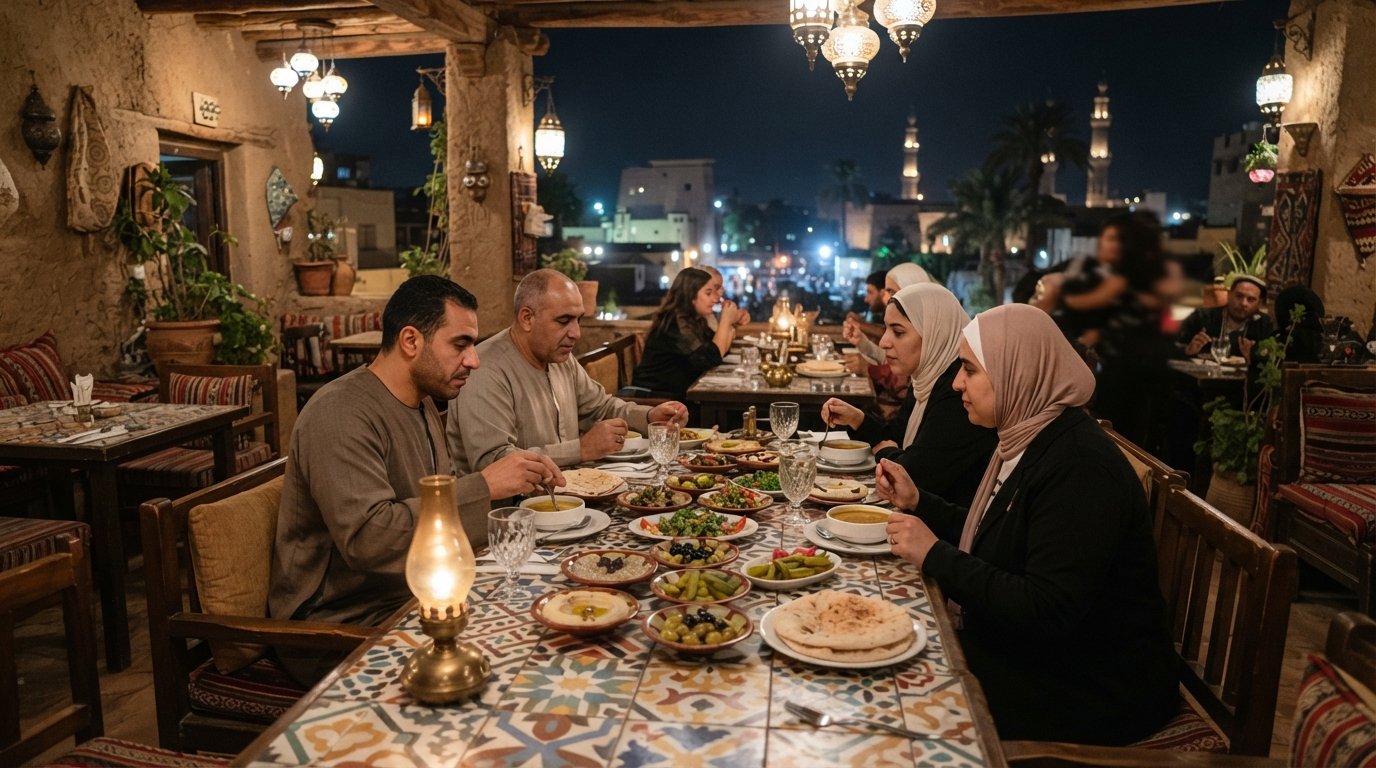
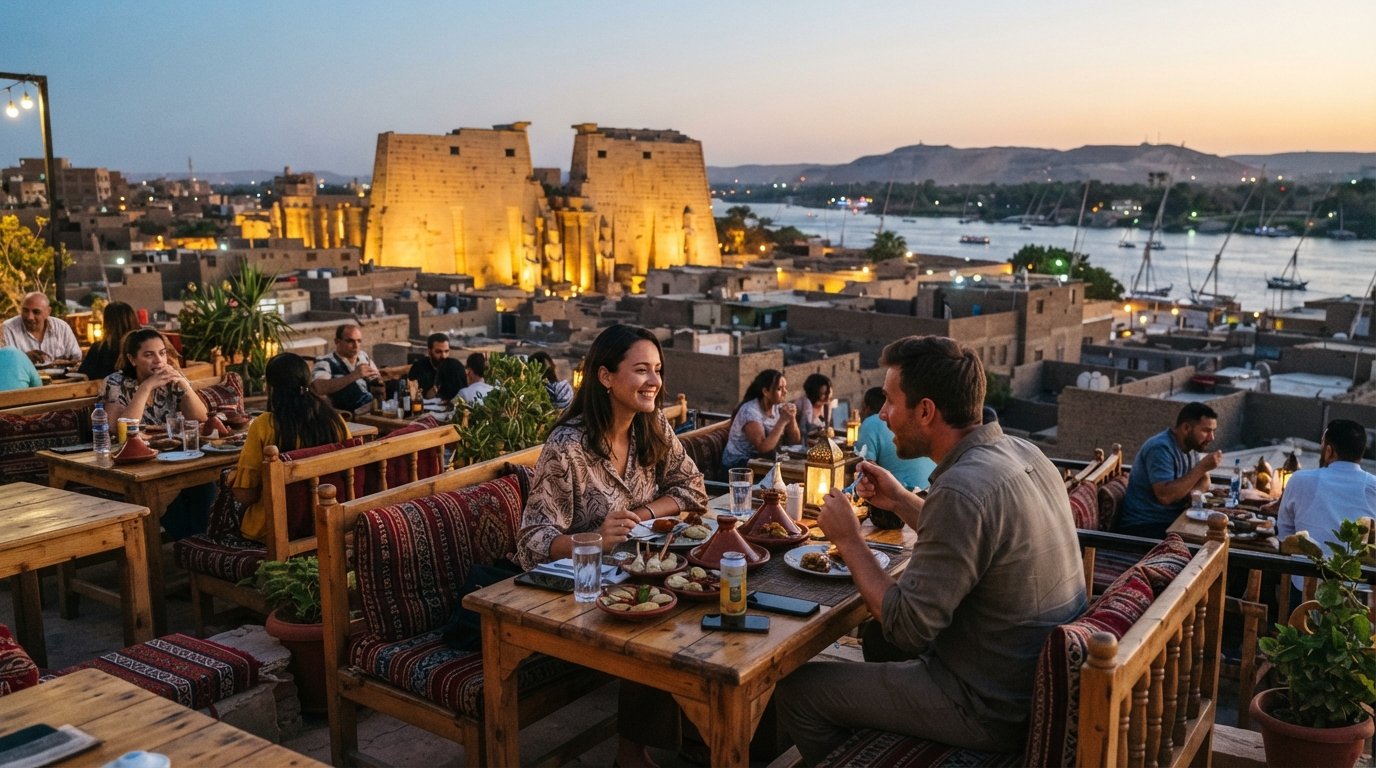
For a rooftop with a view, Al-Sahaby Lane sits atop the Nefertiti Hotel a couple of streets back from the temple. The family traces it to the 1930s, and the kitchen has the easy confidence of a place that has been feeding travellers for generations. Order the camel-meat pot if you want the dish people talk about later, then look up: from here, Luxor Temple sits floodlit in front of you while the city softens into evening around it. It is the kind of dinner that feels choreographed by the skyline.
Right on the Corniche, opposite the Winter Palace, El-Kababgy is the grill house of choice. This is where you go for charcoal kebab, kofta and shish tawook, with fatta and feteer on the side, and for the simple pleasure of eating over the Nile while the West Bank hills sit dark on the far bank. It is not trying to be mysterious. It is trying to be dependable, and it is.
For a change of register, Pizza Roma on El-Mahdi/St Joseph Street near the Sonesta is a clean, reliable answer to the very human desire for wood-fired pizza and pasta after a day of temples. It is open noon to midnight, which makes it useful in the way good travel restaurants should be: forgiving, predictable, and easy to recommend to anyone who has had enough spices for one day.
Aboudi, near Luxor Temple, is the quick-and-cheap café to keep in your pocket. Sandwiches, grills, and decent Wi-Fi are the point here, not ceremony. That matters in a neighbourhood where the grand gestures can come at you all day long; sometimes you just want a cold drink, a working connection, and a chair.
Alcohol is limited to licensed hotels and a few restaurants, so the drinking culture here leans toward tea, coffee and shisha rather than cocktails. That is not a drawback so much as part of the street’s grammar. The Corniche is for lingering, not rushing.
Going out
Nightlife on the East Bank is dinner-led and gentle rather than a club scene, and that suits the place. The move is a rooftop table at sunset, then a slow walk along the Corniche as the river turns to mirror-black and the palm trees flick on their fairy lights. Al-Sahaby Lane and the Nefertiti Hotel terrace both frame the floodlit temple and the Nile, which is about as good a reminder as any that Luxor’s evenings are built around sightlines.
Shisha cafés line the promenade and the streets behind it, where locals and visitors nurse mint tea, Turkish coffee and fruit-flavoured water pipes until late. The atmosphere is social without being hurried. You sit, you watch, you trade a little small talk, and the city keeps moving around you. Because the city is largely dry, any drink with alcohol means a licensed hotel bar or one of the few restaurants that can serve it. The rest of the night belongs to the street.
The one genuinely theatrical after-dark outing is the Karnak Sound & Light Show at the northern end of downtown. It is a 75-minute walk-through spectacle of narration, music and coloured light that ends seated by the Sacred Lake, with headphone translation in several languages and multiple showtimes each evening. It can sound like a tourist add-on until you are inside it, walking through the temple under lights, hearing the old story told in a darkened space that already knows how to carry drama. Book the earlier English slot if you want a shorter taxi queue afterwards.
Things to do / what to see
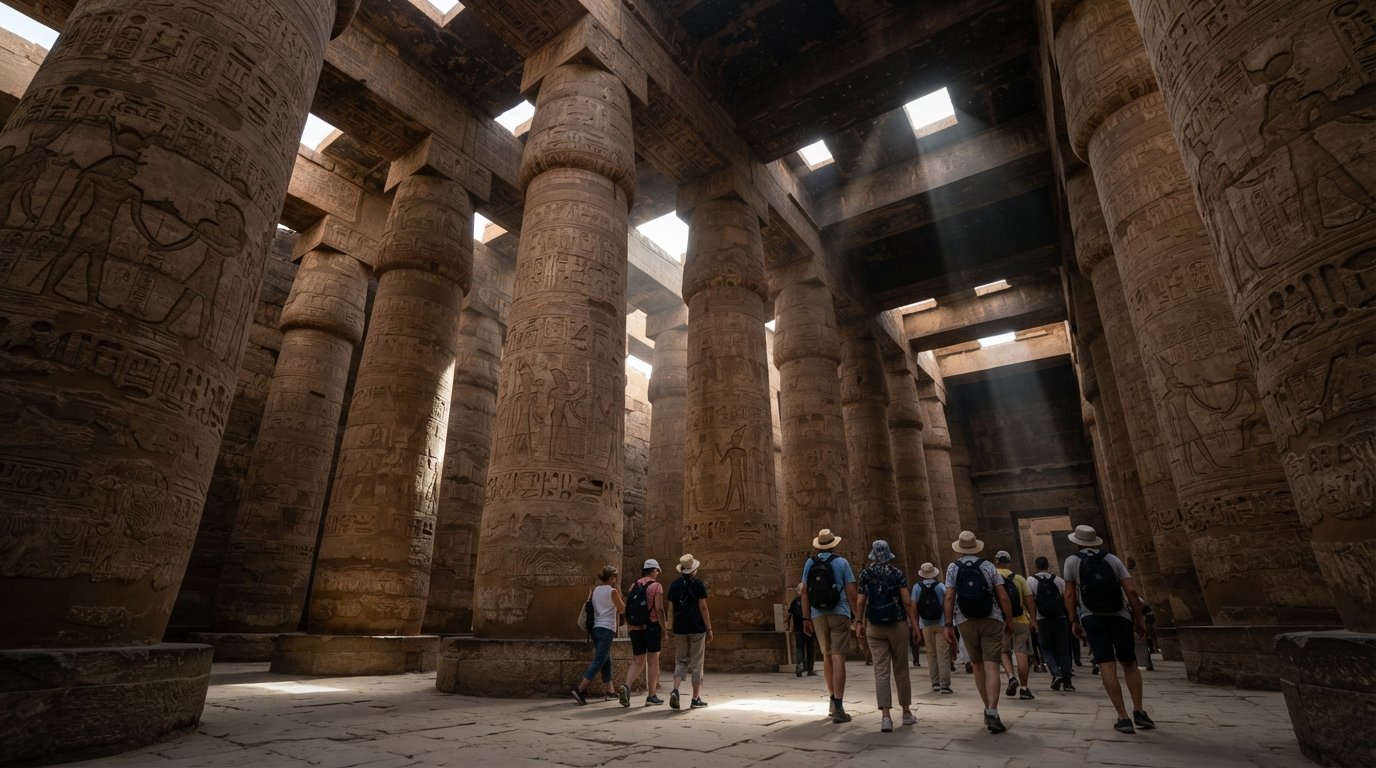
The obvious pair is the two great temples, and downtown is generous enough to let you do them properly. Luxor Temple is a five-minute walk from most hotels and best seen twice: briefly by day, then again after dark when the floodlights and cooler air transform it. Karnak, at the top of the East Bank, is the larger, more overwhelming stop, and it needs a couple of hours. The Great Hypostyle Hall, with its 134 columns, is the set-piece, the room that makes you understand why people still use the word monumental with a straight face.
Walk or ride the Avenue of Sphinxes between them if you want the full ceremonial approach. It is the route that makes the city’s ancient logic visible again, and even now, with modern traffic and the noise of downtown close by, it still feels like a procession rather than a commute.
The smaller museums matter too. The Luxor Museum on the Corniche is compact, superbly displayed, and worth visiting for its beautifully lit statuary. The Mummification Museum nearby is the more specialised stop, focused on embalming, tools and preserved animals. Between them, they give the West Bank tombs and the East Bank temples a human scale. They remind you that Thebes was not only built for kings and gods; it was maintained by technicians, priests and craft.
Then there are the two quintessential Nile experiences at day’s end. Hire a felucca from the Corniche for a slow sunset sail, and agree the price and duration before you step aboard — roughly a handful of dollars for an hour per boat. Or take a calèche ride along the river if the horse looks well cared for and the driver is upfront about the fare. Both are simple pleasures, but in a city this theatrical, simple pleasures matter. They let you watch the skyline change rather than chase it.
Downtown is also the launch point for the region’s headline dawn experience: a hot-air balloon over the West Bank tombs, with hotel pickups leaving the East Bank well before sunrise. That is not an East Bank sight in the strict sense, but it is part of the district’s practical power. Stay here and the machinery of seeing is already at your door.
Don’t miss in East Bank - Downtown
Luxor Temple
The Avenue of Sphinxes
The lively local souq
Shopping & markets
Shopping downtown means the souk, or El-Souk, the covered bazaar that runs off Sharia el-Souk about a ten-minute walk behind Luxor Temple and roughly parallel to the Corniche. The front stretch is unabashedly touristy: alabaster vases, scarab and Eye-of-Horus trinkets, papyrus, leather sandals, Egyptian-cotton scarves and galabiyas. It is the part of the market that knows exactly who is passing through, and it does not pretend otherwise.
Push deeper and the market turns into the one Luxorians actually use, with sacks of hibiscus, cumin, cinnamon and dukkah, piles of dates and pomegranates, and fresh baladi bread. That is where the place becomes more than a shopping strip. It becomes a working city market again, with the tourist layer peeling back just enough to show what people here actually buy.
Bargaining is expected and part of the fun: start well below the asking price, keep it friendly, and be ready to walk away. Cash in Egyptian pounds is king; card acceptance is patchy. Come early for a calmer browse or in the evening when the lanes are lantern-lit and smell of grilling kebabs. If you want the good stuff, alabaster and spices are the local specialities — though much of the alabaster is machine-carved, so handle a few pieces before you commit.
Where to stay in East Bank - Downtown
This is the most convenient base in Luxor, full stop. You can walk to Luxor Temple, the souk, the ferry and the train station, and the hotel range is the widest in the city, from budget guesthouses to five-star Nile-view resorts. That convenience is the point of staying here: you trade a little quiet for the ability to move through the city on foot and come back to a room between sights without thinking about logistics.
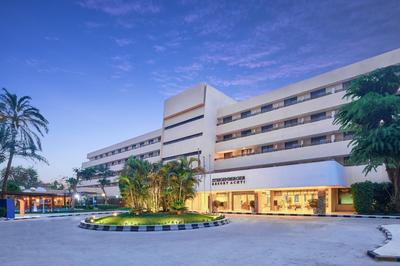
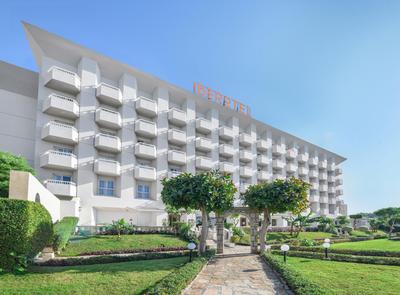
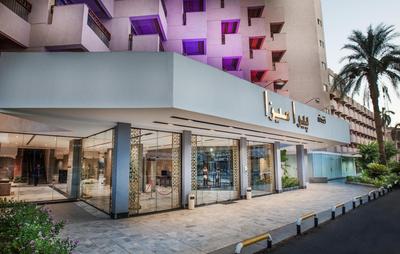
At the top end, the Steigenberger Nile Palace is the dependable five-star choice, a big riverfront resort with pools and Nile-facing rooms. The Hilton Luxor Resort & Spa, a short way north, is the modern-luxury option, with infinity pools and superb balloon-at-dawn views across the water. In the mid-range, the Sonesta St. George and its Nile-view terrace are reliable. For character on a budget, the Nefertiti Hotel is the pick: walkable, family-run, three-star, and home to Al-Sahaby restaurant on the roof.
Budget guesthouses cluster in the streets a block or two behind the Corniche, many with their own rooftop terraces. The closer you are to the temple and the river, the higher the price; step one street back and the value improves quickly. One important note for planners: the Winter Palace, the 1886 colonial grande dame where Howard Carter announced Tutankhamun’s tomb from the terrace in 1922, is closed for a full restoration and is due to reopen as the Mandarin Oriental Winter Palace in 2027, so it and the 1886 Restaurant are not bookable in the meantime.
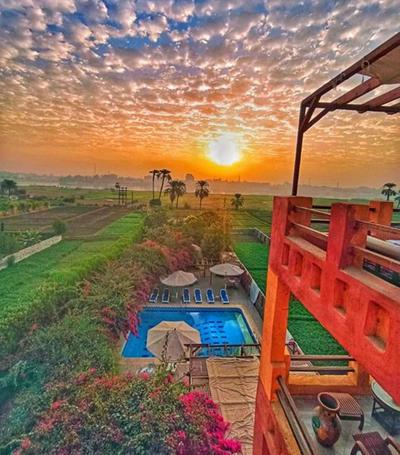
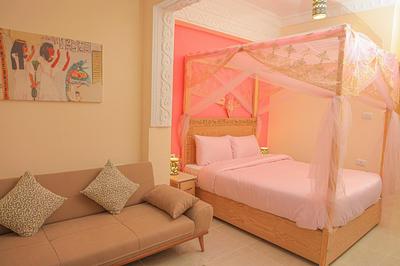
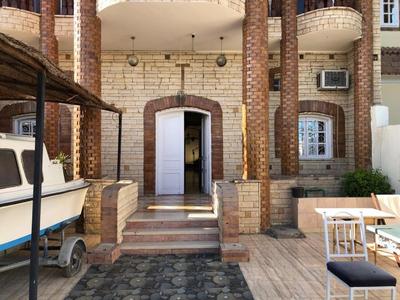
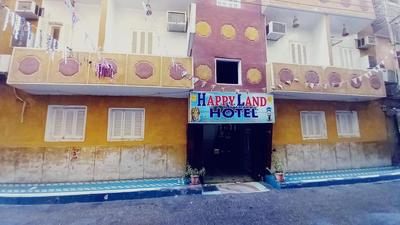
Hotels in East Bank - Downtown
Our best-rated stays in this neighbourhood. Prices are approximate “from” rates — confirmed at the provider when you continue. We may earn a commission if you book through our partners — at no extra cost to you.
In this area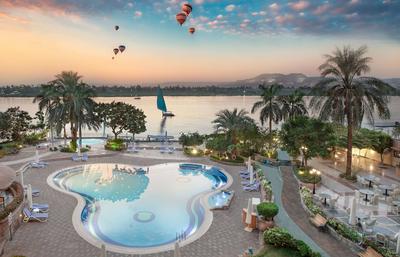 In this area
 In this area
 In this area
 In this area
 In this area
 In this area
 In this area
 In this area
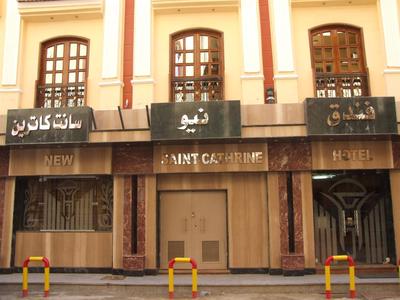 In this area
Getting around
The East Bank is small enough to walk. Luxor Temple, the museums, the souk and most hotels sit within a compact grid along and just behind the Corniche, which means that the neighbourhood’s best argument for itself is often the simplest one: you do not need to keep getting into vehicles.
For anything farther, taxis are cheap and everywhere. Short hops along the Corniche run roughly LE10-20, but always agree the fare before you get in, since meters are not used. Ride-hailing exists in a limited way: Uber does not operate in Luxor, but inDrive does, which takes some of the haggling out of it.
Calèches are the touristy-but-fun way to potter along the river. They are part of the street’s visual language, but the same rules apply as everywhere else here: check the horse looks healthy and fix the price first. Luxor railway station is downtown, only a few minutes’ walk or a short taxi from the Corniche hotels, with sleeper and day trains to Cairo and Aswan. Luxor International Airport is about 15-20 minutes east of downtown by taxi, with a budget of roughly LE80-150 to an East Bank hotel. To reach the West Bank tombs, the cheap local ferry crosses from the Corniche in minutes to Al-Gezira, where you pick up a taxi or bike.
Gallery
East Bank - Downtown in pictures
East Bank - Downtown — your questions
Is the East Bank a good area to stay in Luxor?
Yes. For most first-time visitors it is the best base: you can walk to Luxor Temple, the souk, the museums, the train station and the West Bank ferry, and you have the widest choice of hotels and restaurants in the city. The trade-off is that it is firmly on the tourist trail and busier and pricier than the rural West Bank; if your trip is mainly about the Valley of the Kings and you want quiet, a West Bank guesthouse may suit you better.
Is the East Bank safe, especially at night?
Generally, yes. The Corniche and temple area stay busy and well-lit into the evening, and walking back from a rooftop dinner is routine. The main nuisance is persistent touts, calèche drivers and souk vendors; a polite but firm no thanks works, and you should always agree prices for taxis, carriages and feluccas before you start. Dress a little more modestly in the souk and residential streets than on the Corniche.
Can I visit Luxor Temple at night?
Yes, and you should if you can. The temple stays open into the evening, with last entry around 7pm, and it is floodlit after dark, when the huge Ramses statues throw dramatic shadows and the heat drops. Many visitors go twice: a short daytime look and a longer evening visit. If you want another after-dark option, the separate Karnak Sound & Light Show is a strong add-on.
Is East Bank - Downtown walkable without a car?
Very much so. Most of the key sights, hotels, restaurants and the souk sit along or just behind the Corniche, and the area is compact enough to cover on foot. For longer hops, taxis, calèches and the local ferry are easy to find.