The Luxor issue
Sidestepping the Touts at Luxor's Temple Gates
The pressure around Luxor's monuments is concentrated in about six car parks and one ferry landing, and you can plan around every one of them.

By Hanne VermeerReading Luxor the way it was built

Luxor keeps its monuments inside a working town of half a million people, so every temple gate has a short stretch of ground in front of it where somebody's living depends on stopping you. That pressure is real, and it is also predictable. It sits in roughly six car parks, one length of corniche railing and one ferry landing, and once you know which six, the rest of a week here is far quieter than the city's reputation suggests.
Where the pressure actually sits
Almost none of it happens inside the monuments. Once a ticket is checked you are on Ministry of Antiquities ground, where selling is not permitted and, on the whole, does not happen. It all happens in the gap between where a vehicle stops and where a ticket is torn: the Karnak ticket-gate car park, the free layby at the Colossi, the walk from car park to ramp at Deir el-Bahari, the corniche railings opposite Luxor Temple in daylight, the west-bank ferry landing, and the shop-lined approach roads in between. Six places. Everywhere else in this city, you are just another person walking.
Two habits cover most of it. First, don't answer questions in a car park. "Where are you from" is not small talk there, it is the opening line of a sales script, and the conversation is where the sale starts. A flat, friendly "no thank you" without breaking stride ends more approaches than any argument, and arguing is what turns thirty seconds into ten minutes. Second, treat anything offered free as a priced item with the price disclosed later: the scarf pressed into your hand, the boy who leads you to a better view, the camel that appears beside you at the Colossi.
None of this is menacing. It is persistent, the volume is high, the heat makes it wearing, and being followed for two hundred metres is tiring at forty degrees. It is not dangerous, and treating it as a threat rather than a trade makes the whole city harder than it is.
Plan your Luxor trip
Live prices from our booking partners.
Free cancellation on many rooms. We may earn a commission when you book.
Karnak before the coaches
Karnak Temple Complex (Karnak, the northern end of the east bank) opens at 06:00, closing at 17:00 and at 18:00 from May to September. Arrive at opening and you get a different temple from the one people see at nine. Coach parties funnel through the first pylon between eight and eleven, so by mid-morning the hypostyle hall is a slow river of people moving between the columns. At six you can stand in it more or less alone, which is when the scale does what it was built to do.

Adult entry is EGP 600 and students EGP 300. The Open Air Museum inside the enclosure is sometimes charged as a separate add-on of around EGP 25, and because it is an extra ticket almost nobody buys it, so it stays the quietest ground in the complex even at eleven. There is no booking and no size limit: coach groups are the norm here and independent visitors are never turned away at the gate. In the evening the Sound and Light show runs at roughly the equivalent of US$20.
The ticket-gate car park is where the calèche drivers and the my-brother-has-an-alabaster-shop pitches cluster, and at six in the morning most of them are not there yet. That is the practical argument for the early start, over and above the light and the temperature.
The temple that stays open after dark
Luxor Temple (on the corniche, town centre) is the one big site open until 21:00, at EGP 400 to 500 for adults and EGP 200 to 250 for students, with no booking needed and groups accepted without fuss. The afternoon belongs to the cruise boats; late evening is markedly thinner. Better still, the ticket allows re-entry the same evening, so you can go in around six for the last of the daylight on the Ramesses statues, eat, and come back at half past eight when the colonnade is floodlit and half empty.
Going after dark also removes the daytime tout line along the corniche railings opposite, the most concentrated sales ground in the town centre. In the evening those railings are mostly families out walking.
Walking the avenue instead of arguing about it
Avenue of Sphinxes (Rams Road) (running the three kilometres between the two temples) is free with a ticket to either one, and you can enter from either end with no separate ticket. Walking it deletes the single most-quoted piece of Luxor friction, the price negotiation for a hop between the two temples. Go after 16:00, because the avenue is sunk below street level with no shade at all and it is a punishing walk at two in the afternoon. Any group size works; it is an open walkway, not a gated site.
The midday refuge
Luxor Museum (corniche, a short walk north of Luxor Temple) costs EGP 400 for adults and EGP 200 for students, and keeps split hours of roughly 09:00 to 12:00 or 13:00, then 17:00 to 19:00 or 20:00. It is air-conditioned, calm, and has no vendors inside the building at all, so it is where to spend the dead heat of the day instead of fighting it. The renovated Cache Hall now shows the full set of statues found buried at Luxor Temple, and it takes groups without ever feeling like it does.
Crossing the river for the price of a coffee
Luxor public Nile ferry (east-bank landing opposite Luxor Temple) runs every ten to fifteen minutes until late and costs EGP 5 to 25 one way. Locals pay the low end; agree your fare before you board, not after. There is no booking and no limit, and you walk on alongside commuters, schoolkids and bicycles, which is why it is the tout-free way to reach the west bank.
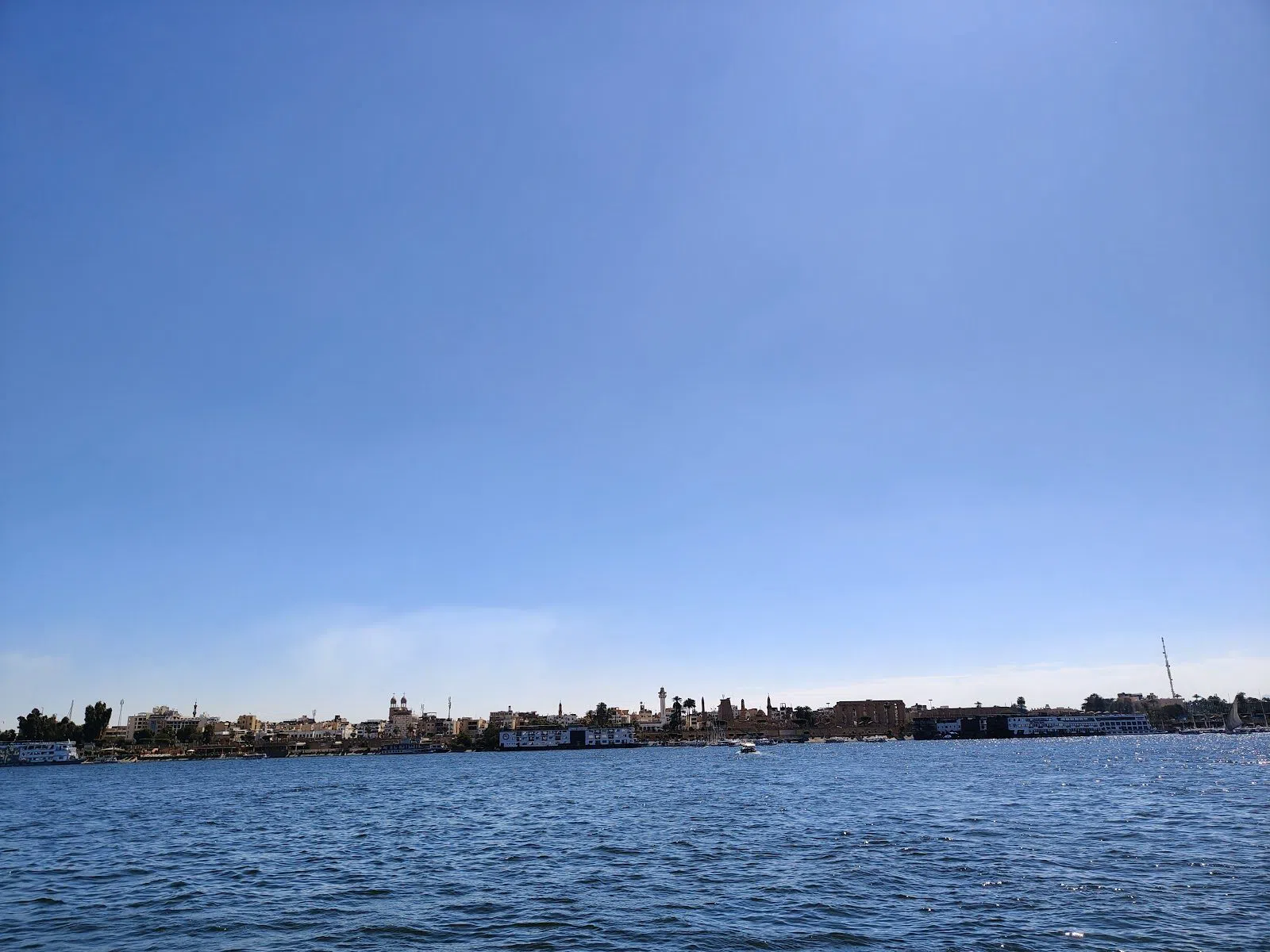
The one thing to watch is the private motorboat crew working the landing, who will quote many times the ferry fare for the identical crossing and will tell you the ferry is not running. The ferry is the big boat with the bicycles on it.
Buy the west-bank tickets before you need them
This is the detail that catches independent visitors out. Several west-bank sites do not sell tickets at their own gates. Medinet Habu, the Ramesseum, Deir el-Medina, the Tombs of the Nobles and the Valley of the Queens are all bought at the Antiquities Inspectorate office, open 08:00 to 16:00, before you drive out to them. Turning up at the gate without one means a round trip back. The Valley of the Kings and the Temple of Hatshepsut have their own ticketing at the site.
Cashless payment is now the 2026 norm at the bigger counters, with card readers standard at the Valley of the Kings visitor centre and Nobles cluster tickets sold cashless. Carry a chip card and a decent float of Egyptian pounds anyway; small sites, the ferry, tips and drivers are all cash.
The Valley of the Kings at opening
Valley of the Kings (west bank, in the desert behind Qurna) charges EGP 750 for the standard ticket covering any three of the roughly ten tombs open on rotation. Tutankhamun in KV62 is a separate EGP 700, Seti I in KV17 is EGP 2,000, and Ramesses V and VI in KV9 is EGP 220. Of the extras, KV9 is the cheapest upgrade and by some distance the best value for what you see overhead; KV17 is the finest tomb in the valley, and its price is a decision you have to make rather than a formality.
Be at the gate at 06:00. By nine the valley is a queue in full sun with no shade anywhere in it, and the tombs themselves get progressively warmer and stuffier through the morning. Groups are standard here and less of an obstacle than they look, because guides must brief outside and cannot lecture inside the tombs. Parties split at every doorway, so you rarely get stuck behind a stationary lecture in a corridor.
Hatshepsut and the twenty-pound shortcut
Temple of Hatshepsut, Deir el-Bahari (west bank, directly under the cliffs) is EGP 440 for adults and EGP 220 for students, plus EGP 20 for the taftaf shuttle from the car park, and opens 06:00 to 17:00, closing at 16:00 in winter. The walk from car park to ramp is the busiest souvenir gauntlet on the west bank, several hundred metres of stalls with nowhere to step aside. The EGP 20 shuttle runs continuously and skips every metre of it, which makes it the cheapest piece of hassle avoidance in Luxor. The site is very group-friendly and the terraces absorb crowds well.
The west bank nobody works
Three sites reward anyone willing to drive ten more minutes. Medinet Habu (southern west bank), at EGP 220 for adults and EGP 110 for students, has the best-preserved colour on the west bank and a fraction of the crowd; the enclosure is large enough to absorb several parties without feeling full. Remember the ticket comes from the Inspectorate office.
The Ramesseum (Qurna, mid west bank) is the same EGP 220 and EGP 110, and usually holds a handful of visitors at any hour. Nobody works the entrance, because there is no trade to be had. The mud-brick granaries behind the ruin are the clearest picture anywhere in Luxor of how a temple actually functioned as an institution and not just a monument.
Temple of Seti I at Qurna (northern west bank), EGP 100 to 220 and open 06:00 to 17:00, is skipped by every coach itinerary. The relief quality is superb and there are no sellers whatsoever, which together make it the best-value stop on this side of the river.
The painted tombs and what to hand the guardian
Deir el-Medina (west bank, in a bowl of hills south of Qurna) costs EGP 220 and EGP 110 for the Sennedjem and Inherkha cluster. This was the village of the men who cut the royal tombs, and the painted chambers are tiny, so visitors go down a few at a time. The pressure here is queueing, not selling. The tomb guardians expect a small note for pointing out details, and they earn it.
Tombs of the Nobles (Sheikh Abd el-Qurna) run roughly EGP 50 to 220 per cluster ticket, sold in clusters of two or three tombs, cashless from 2026. The daily-life painting here is better than anything in the royal valleys and there is almost nobody in it. In practice it works as a small-group site, because the chambers are cramped. The guardians unlock, light the walls and then expect a tip.
Valley of the Queens (west bank), EGP 220 and EGP 110, is small and rarely congested. Nefertari's tomb, QV66, has been closed since March 2024 with no announced reopening. Anyone offering you a Nefertari ticket is telling you what every other offer they make that day is worth, so it doubles as a free test.
On tipping generally: unlocking a sealed chamber and lighting a painted wall is a service, not a pitch, and it is worth separating the two in your head. Keep a wad of EGP 10 and 20 notes and hand one over at the end.
The layby with the hardest sell in Luxor
Colossi of Memnon and Kom el-Hettan (on the west-bank road, on the way in from the ferry) is free for the statues, with nominal entry to the temple field behind, which keeps standard 06:00 to 17:00 hours. The restored colossi were unveiled in December 2025 and the site is finally worth more than a two-minute photo stop.
It is also where the alabaster-factory pitch is made hardest, because it costs nothing to stand there and so everyone does. The workshop stop is a commission arrangement and your driver is being paid to deliver you to it. Settle the itinerary before you set off, name the stops you want, say plainly that there are no shopping stops, and the argument happens once in a hotel lobby instead of five times at the roadside.
When to just buy the day

Djed Egypt Travel (a licensed Luxor operator, Egyptian Travel Agents Association member no. 1333) runs private half- and full-day itineraries with Egyptologist guides at roughly US$35 to 120 per person per day, tiered for 2, 3, 4 and 5 or more people. The honest read: if you have a week here, reasonable heat tolerance and no small children, you do not need it. The ferry and the Inspectorate office cover you for a fraction of the money and the city is walkable and navigable alone.
If you have two days, are travelling with kids or elderly parents, or simply do not want to spend a holiday negotiating, booking one licensed guide for a day makes every ticket queue, driver and gate approach someone else's problem. Because the pricing is private and not per seat, couples pay the most per head and four or five people is where it turns genuinely cheap.
The day trip that removes the negotiation entirely
Temple of Hathor, Dendera (about an hour north along the Nile) charges around EGP 300 and opens 07:00 to 17:00 with last entry at 16:00. The ceiling colour there beats anything in Luxor itself, and most visitors arrive in chartered cars or minibuses instead of on a coach. A driver for the day typically runs EGP 1,500 to 2,500 for the car, not per person. Agree that one number for the round trip including waiting time before you get in, and the entire day's haggling is finished in a single sentence.
Practicalities
Transport. The ferry at EGP 5 to 25 handles every east-west crossing; agree the fare before boarding, and ignore the motorboats. Taxis and minibuses wait at the west-bank landing, and the same rule applies there: price agreed before the door closes, and a full-day car quoted as one number, not per stop. Between the two east-bank temples, walk the avenue.
Cash. Card readers are standard at the Valley of the Kings visitor centre and Nobles tickets are cashless from 2026, but carry Egyptian pounds in small notes for the ferry, drivers, the taftaf and tomb guardians. A chip card plus a cash float covers every counter in the city.
Timing. Gates at 06:00 for the west bank and Karnak. Luxor Museum through the midday heat. Avenue of Sphinxes after four, Luxor Temple after dark on its re-entry ticket. That single rhythm removes both the crowds and the worst of the sun.
Budget. A full east-bank day of tickets comes to about EGP 1,450: Karnak at 600, Luxor Temple at roughly 450, the museum at 400. A full west-bank day runs about EGP 1,650 with the standard Valley of the Kings ticket at 750, Hatshepsut at 440 plus the 20 shuttle, and Medinet Habu and the Ramesseum at 220 each. Allow another EGP 300 to 500 a day for the ferry, tips and small extras, plus the car if you are not using taxis piecemeal.
Where you sleep changes the plan. A corniche room near Luxor Temple makes the evening re-entry trick effortless and puts the avenue on your doorstep, while a west-bank stay trades restaurants for silence and puts the tombs fifteen minutes from your bed. Compare both sides on the Luxor hotel search, and read the rest of the city in the Luxor guide.
Before you go
Are the touts around Luxor's temples dangerous?
No. The pressure is commercial and persistent rather than threatening, and it sits in a few predictable places: the Karnak ticket-gate car park, the Colossi layby, the walk to the Hatshepsut ramp, the corniche railings and the ferry landing. Selling is not permitted inside any ticketed site, and it effectively does not happen. A flat, friendly refusal without stopping ends most approaches; arguing extends them.
What time should I arrive at Karnak and the Valley of the Kings?
Both open at 06:00, and arriving at opening changes both of them. Coach parties reach Karnak's first pylon between 08:00 and 11:00, and by 09:00 the Valley of the Kings is a queue in full sun with no shade anywhere. Early also means fewer sellers in the car parks, because most have not set up yet.
Do I need a guide in Luxor, or can I visit the temples independently?
Independent travel is entirely workable. The public ferry costs EGP 5 to 25, the temples take no booking, and tickets come from the gate or the Antiquities Inspectorate office. A licensed operator like Djed Egypt Travel (roughly US$35 to 120 per person per day) earns its money if you have only two days, are travelling with children or older parents, or want someone else to handle the queues and drivers. Private pricing means couples pay the most per head.
Can I still visit Nefertari's tomb in the Valley of the Queens?
No. QV66 has been closed since March 2024 with no announced reopening. Anyone offering you a Nefertari ticket is selling something that does not exist, which tells you what their other offers are worth. The rest of the Valley of the Queens stays open at EGP 220 for adults and EGP 110 for students.
How much cash should I carry, and can I pay by card?
Card readers are standard at the Valley of the Kings visitor centre, and Tombs of the Nobles cluster tickets are cashless from 2026, so carry a chip card. You still need Egyptian pounds in small notes for the ferry, taxis, the EGP 20 Hatshepsut shuttle and tips for tomb guardians. Budget roughly EGP 1,450 in tickets for a full east-bank day and EGP 1,650 for a full west-bank day, plus EGP 300 to 500 for extras.